From if-else to Design Patterns: Architecting a Vehicle Management System 從 if-else 到設計模式:架構一套公司車輛管理系統
For our Software Framework Design final project at Feng Chia University, my teammate and I built a Corporate Vehicle Management System — a platform for employees to request company vehicles, and for managers to approve, dispatch, and track them through maintenance. I owned the system architecture, the application of OOD principles, and the backend API; my teammate built the Vue 3 frontend and the database layer.
The interesting part of this project wasn’t the CRUD — it was using it as an excuse to apply SOLID, the Law of Demeter, and six GoF design patterns the way they’re meant to be used: not for their own sake, but to make a genuinely messy domain stay readable as it grows. This post is a tour of the decisions that mattered.
The stack
| Layer | Choice |
|---|---|
| Backend | Spring Boot 3.3.4 |
| Security | Spring Security + JJWT (stateless JWT, BCrypt) |
| Persistence | PostgreSQL + Spring Data JPA, Flyway migrations |
| Frontend | Vue 3 + TypeScript, Pinia, Vite |
Layered architecture, and why the domain owns its interfaces
The backend is split into clear layers — Presentation → Service → Domain → Repository Interface → Infrastructure — but the layer that earns its keep is the Repository Interface boundary. Following the Dependency Inversion Principle, the domain and service layers depend only on interfaces they define; the JPA-backed implementations live out in infrastructure and depend inward.
// Domain owns the contract it needs
public interface IBorrowingRepository {
    BorrowingRequest save(BorrowingRequest request);
    Optional<BorrowingRequest> findById(Long id);
    List<BorrowingRequest> findOverlapping(Long vehicleId, Instant start, Instant end);
}
That one inversion buys two concrete wins: the service layer is testable with a tiny in-memory repository (no database, no Spring context), and swapping persistence later never touches the domain. The JPA classes plug in through the Adapter pattern — more on that below.
The centrepiece: the State pattern
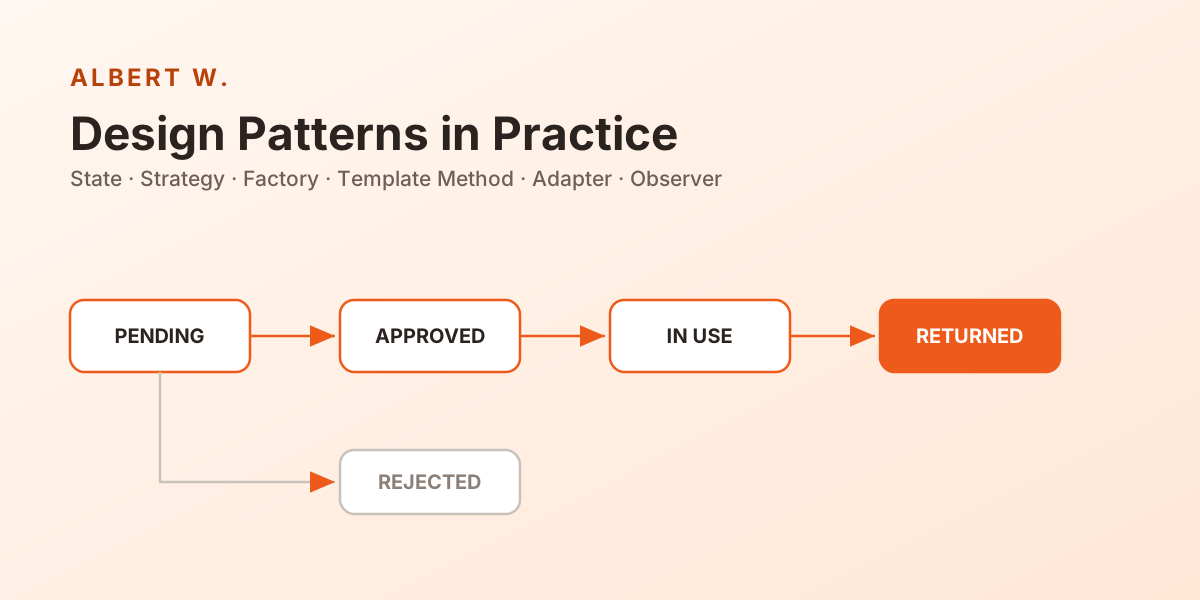
A borrowing request moves through a strict lifecycle:
PENDING ──approve──▶ APPROVED ──startUse──▶ IN_USE ──complete──▶ RETURNED
   │
   └────reject────▶ REJECTED
Each state allows only certain transitions. The naive version of this is a swamp of if (status.equals("PENDING")) … else if … checks scattered across the service layer — and every new rule makes it worse. Instead, the request (the Context) holds a BorrowingState, and each concrete state encapsulates exactly the transitions it permits.
// Context — delegates every action to the current state
public class BorrowingRequest {
    private BorrowingState state = new PendingState();

    public void approve(String note)   { state.approve(this, note); }
    public void reject(String note)    { state.reject(this, note); }
    public void startUse()             { state.startUse(this); }
    public void complete(int mileage)  { state.complete(this, mileage); }

    void transitionTo(BorrowingState next) { this.state = next; }
    public String getStateName()           { return state.getStateName(); }
}
The interface makes illegal the default. A state only overrides the operations it actually allows; everything else throws — which the API maps to HTTP 422 Unprocessable Entity.
public interface BorrowingState {
    default void approve(BorrowingRequest r, String note) { illegal(); }
    default void reject(BorrowingRequest r, String note)  { illegal(); }
    default void startUse(BorrowingRequest r)             { illegal(); }
    default void complete(BorrowingRequest r, int mileage){ illegal(); }
    String getStateName();

    private void illegal() {
        throw new InvalidStateTransitionException(); // → 422
    }
}

public class PendingState implements BorrowingState {
    public void approve(BorrowingRequest r, String note) { r.transitionTo(new ApprovedState()); }
    public void reject(BorrowingRequest r, String note)  { r.transitionTo(new RejectedState()); }
    public String getStateName() { return "PENDING"; }
}
Now “you can’t start a trip on a request that was never approved” isn’t a comment or a forgotten if — it’s enforced by the type system: only ApprovedState overrides startUse, so every other state inherits the throwing default. The hierarchy keeps the rules for you.
The supporting cast
Five more patterns each solved one specific pain point:
-
Strategy — conflict checking. Whether two bookings clash is a policy that might change, so the check lives behind a
ConflictCheckStrategyinterface (StrictOverlapStrategyis the default). Swapping in a “same-day buffer” rule later means one new class, not an edit to the booking service. -
Factory Method — role creation.
RoleFactoryturns aRoleTypeinto the rightRoleobject (AdminRole,ManagerRole,EmployeeRole), so the rest of the code never news-up a role by hand or branches on its type. -
Template Method — permission guard. An
AbstractProtectedServicedefines the fixed “check permission, then do the work” skeleton; concrete services fill in the work. Authorization can’t be forgotten because it’s baked into the template. -
Adapter — repository bridging.
*RepositoryAdapterclasses implement the domain’s repository interfaces by delegating to Spring Data JPA repos, mapping between domain models and JPA entities. The domain never imports anything fromjakarta.persistence. -
Observer — notifications. A
BorrowingEventPublisherfires domain events; anEmailNotificationObserverreacts. Adding an SMS or Discord notifier later is a new observer, with zero changes to the borrowing flow.
What I took away
Design patterns get a bad reputation because they’re easy to over-apply. The lesson from this project was the opposite: reach for a pattern when a specific force pushes back — a tangle of status branches (State), a policy that will change (Strategy), a cross-cutting rule that keeps getting skipped (Template Method). Used that way, each pattern paid for itself by making the next change smaller.
The other quiet win was the DIP boundary. Being able to unit-test the entire service layer against in-memory repositories — no Postgres, no Spring — turned the test suite from a chore into something fast enough to actually run while coding. That, more than any single pattern, is what kept the codebase honest.
You can browse the full source on GitHub.
在逢甲大學 軟體框架設計 的期末專題中,我和組員一起打造了一套 公司車輛管理系統 ── 讓員工申請公司車輛,並讓主管審核、派車,以及追蹤後續的保養。我負責 系統架構設計、OOD 原則應用與後端 API 實作,組員則負責 Vue 3 前端與資料庫層。
這個專案有趣的地方不在 CRUD,而在於把它當成一個藉口,去「正確地」運用 SOLID、迪米特法則與六個 GoF 設計模式 ── 不是為了用而用,而是為了讓一個本質上很雜亂的領域,在持續長大時仍然保持可讀。這篇文章就帶你走過幾個真正關鍵的決策。
技術選型
| 層級 | 選擇 |
|---|---|
| 後端 | Spring Boot 3.3.4 |
| 安全認證 | Spring Security + JJWT(無狀態 JWT、BCrypt) |
| 持久化 | PostgreSQL + Spring Data JPA、Flyway 遷移 |
| 前端 | Vue 3 + TypeScript、Pinia、Vite |
分層架構,以及為什麼領域要「擁有」自己的介面
後端切分成清楚的層級 ── Presentation → Service → Domain → Repository 介面 → Infrastructure ── 但真正撐起整個設計的,是 Repository 介面 這道邊界。依循 依賴反轉原則(DIP),領域層與服務層只依賴於它們 自己 定義的介面;JPA 實作則住在 infrastructure,並反過來向內依賴。
// 領域層擁有它需要的契約
public interface IBorrowingRepository {
    BorrowingRequest save(BorrowingRequest request);
    Optional<BorrowingRequest> findById(Long id);
    List<BorrowingRequest> findOverlapping(Long vehicleId, Instant start, Instant end);
}
光是這一次反轉,就換來兩個具體好處:服務層可以用一個極小的 記憶體版 Repository(不需要資料庫、不需要 Spring context)來測試;而日後要更換持久化方案,也完全碰不到領域層。JPA 類別透過 Adapter 模式 接上 ── 稍後再談。
核心:State 模式
一筆借車申請會走過一條嚴格的生命週期:
PENDING ──approve──▶ APPROVED ──startUse──▶ IN_USE ──complete──▶ RETURNED
   │
   └────reject────▶ REJECTED
每個狀態只允許特定的轉換。最天真的寫法,是在服務層四處散落 if (status.equals("PENDING")) … else if …,而且每加一條規則就更糟。我們的做法是:申請(Context)持有一個 BorrowingState,而每個具體狀態只封裝它所允許的轉換。
// Context ── 把每個動作委派給當前狀態
public class BorrowingRequest {
    private BorrowingState state = new PendingState();

    public void approve(String note)   { state.approve(this, note); }
    public void reject(String note)    { state.reject(this, note); }
    public void startUse()             { state.startUse(this); }
    public void complete(int mileage)  { state.complete(this, mileage); }

    void transitionTo(BorrowingState next) { this.state = next; }
    public String getStateName()           { return state.getStateName(); }
}
介面讓「非法」成為預設值。每個狀態只覆寫它真正允許的操作,其餘一律拋出例外 ── API 再把它對應到 HTTP 422 Unprocessable Entity。
public interface BorrowingState {
    default void approve(BorrowingRequest r, String note) { illegal(); }
    default void reject(BorrowingRequest r, String note)  { illegal(); }
    default void startUse(BorrowingRequest r)             { illegal(); }
    default void complete(BorrowingRequest r, int mileage){ illegal(); }
    String getStateName();

    private void illegal() {
        throw new InvalidStateTransitionException(); // → 422
    }
}

public class PendingState implements BorrowingState {
    public void approve(BorrowingRequest r, String note) { r.transitionTo(new ApprovedState()); }
    public void reject(BorrowingRequest r, String note)  { r.transitionTo(new RejectedState()); }
    public String getStateName() { return "PENDING"; }
}
於是「不能對一筆從未核准的申請開始出車」不再是一行註解、或某個被遺忘的 if,而是 ── 在 PendingState 上 沒有 覆寫 startUse。編譯器與型別階層會替你把規則守住。
配角群
另外五個模式,各自解決了一個具體的痛點:
-
Strategy ── 時段衝突檢查。 兩筆預約是否衝突是一條「可能會變」的政策,因此檢查邏輯藏在
ConflictCheckStrategy介面後(預設為StrictOverlapStrategy)。日後要換成「同日緩衝」規則,只是多一個類別,而不是去改借車服務。 -
Factory Method ── 角色建立。
RoleFactory把RoleType轉成正確的Role物件(AdminRole、ManagerRole、EmployeeRole),讓其餘程式碼永遠不必自己 new 角色、也不必對型別做分支。 -
Template Method ── 權限守衛。
AbstractProtectedService定義了固定的「先檢查權限,再做事」骨架,具體服務只負責填入「做事」的部分。授權檢查不可能被遺漏,因為它被烤進了樣板裡。 -
Adapter ── Repository 橋接。
*RepositoryAdapter類別透過委派給 Spring Data JPA repo 來實作領域的 Repository 介面,並在領域模型與 JPA Entity 之間做轉換。領域層永遠不會 import 任何jakarta.persistence的東西。 -
Observer ── 事件通知。
BorrowingEventPublisher發出領域事件,EmailNotificationObserver負責反應。日後要加 SMS 或 Discord 通知,只是新增一個觀察者,借車流程一行都不用改。
我的收穫
設計模式之所以名聲不好,是因為太容易被 過度 使用。這個專案給我的教訓恰恰相反:當某個具體的「力」在反推你時,才去拿出對應的模式 ── 一堆糾結的狀態分支(State)、一條注定會變的政策(Strategy)、一條老是被略過的橫切規則(Template Method)。這樣使用,每個模式都會以「讓 下一次 修改變小」來回報你。
另一個安靜的勝利,是 DIP 那道邊界。能夠用記憶體版 Repository 對整個服務層做單元測試 ── 不需要 Postgres、不需要 Spring ── 讓測試套件從一件苦差事,變成快到「真的會在寫程式時順手跑」的東西。比起任何單一模式,這才是讓整個程式碼庫保持誠實的關鍵。
完整原始碼可以在 GitHub 上瀏覽。